CALL at IMISCOE 2026: rethinking the digital gap in migrants’ access to public services
Envisioning Translocality
Enabling Institutions
Enforcing Practices
CALL Research Lab participated in the 23rd IMISCOE Annual Conference 2026, held in Girona, Spain, from 29 June to 2 July 2026. This year’s conference theme, “Strengthening Migration Studies through Community Engagement”, offered an important space for academic exchange on migration, integration, social cohesion, and the role of communities in shaping research agendas and practices.
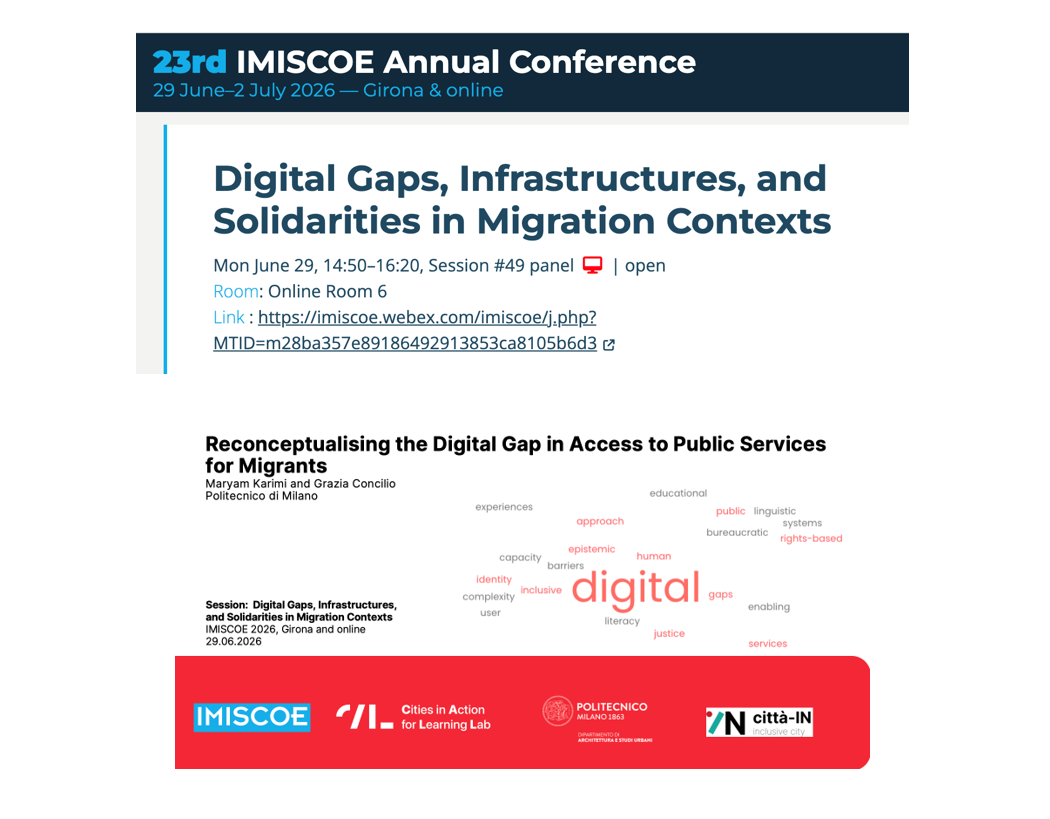
On Monday, 29 June, Maryam Karimi presented in Session #49, “Digital Gaps, Infrastructures, and Solidarities in Migration Contexts”, an online panel exploring how migrants navigate increasingly digitalised systems of governance, service provision, and citizenship. The session examined how digital technologies can simultaneously reproduce exclusion and open new possibilities for solidarity, participation, and access to rights.
Maryam Karimi presented the paper “Reconceptualising the Digital Gap in Access to Public Services for Migrants”, co-authored with Grazia Concilio. The paper examined how the rapid digitalisation of public administrations across the EU is reshaping migrants’ access to essential services while claiming to improve efficiency, also deepening existing inequalities. Rather than understanding the digital gap only as a matter of interface usability or access to technology, the presentation conceptualised it as a multidimensional phenomenon produced through four interrelated dimensions: limited digital literacy and experience; persistent bureaucratic complexity; educational and linguistic barriers; and the limited enabling capacity of services to support users in navigating digital procedures. Drawing on empirical findings from the città-IN project, the paper showed how these dimensions intersect in migrants’ everyday encounters with public services, particularly for migrant women and people with low or no literacy. The presentation also briefly introduced Parliamo di Scuola “Let’s Talk of School”, a hybrid service manual developed with migrant mothers in Milan, as an example of a service-specific tool designed to respond to these layered barriers.
The panel also included presentations by Liubov Iashchenko from Sapienza University of Rome, with the paper “Vernacular Legality and Digital Infrastructures of Solidarity: Everyday Law among Post-Soviet Migrants in Italy”; Allison Petrozziello and Junyuan Lin from Toronto Metropolitan University, with “Finding the Lost Canadians: Advanced Digital Technologies and the Reintegration of the Next Generation”; and Mu-Jeong Kho from University College London, with “Can Multilingual Digital Technology Truly Act as a Trigger to Self-Organise a New Resilient System of Migrant Healthcare?”
The session was closely aligned with the CALL Research Lab’s interests in inclusive service design, digital transformation, urban innovation, migration, and the co-production of knowledge with communities. It offered a valuable opportunity to reflect on how digital infrastructures shape access to rights and services, and on how research can support more equitable and situated approaches to public service innovation.
CALL looks forward to continuing these conversations and strengthening collaborations around migration, digital inclusion, and community-engaged research.